
Meta Title: Meta Description: URL Slug: /blog/ Primary Keyword: Secondary Keywords: moving box calculator, boxes needed 3 bedroom house, how many boxes for a 2 bedroom
Almost everyone underestimates this. You look around your home, count the visible furniture, and think you’ll need “maybe twenty boxes.” Then you open the kitchen cupboards, the linen press, and the storage cage under the stairs — and twenty becomes seventy very quickly.
Running out of boxes mid-pack is one of the most common reasons Melbourne moves fall behind schedule. It sends you to the hardware store on a Saturday morning when you should be taping cartons, and it leaves half-packed rooms for the removalists to work around, which costs you time on an hourly rate.
This guide gives you a straightforward moving box calculator by home size, a room-by-room breakdown, and the box types that actually matter. The numbers come from what our crews load off real Melbourne homes — not a generic estimate.
The Quick Answer: How Many Boxes Do I Need to Move?
Here’s the short version. These figures assume an averagely furnished home where the occupants have lived for two to three years.
| Home size | Total boxes | Small | Medium | Large | Wardrobe |
| Studio / bedsit | 15–25 | 6 | 8 | 4 | 1 |
| 1 bedroom apartment | 25–35 | 10 | 12 | 8 | 2 |
| 2 bedroom home | 40–55 | 16 | 20 | 12 | 3 |
| 3 bedroom house | 60–80 | 24 | 28 | 18 | 4 |
| 4 bedroom house | 85–110 | 32 | 38 | 25 | 6 |
| 5+ bedroom house | 120–150+ | 45 | 50 | 35 | 8 |
Add roughly 15% to whichever number applies to you. Spare boxes cost a few dollars; a second trip to buy more costs you an hour.
How the Moving Box Calculator Works
Box count isn’t really about bedrooms — bedrooms are just the easiest proxy. What actually drives the number is four things.
Occupancy. Two people in a three bedroom house own far less than a family of five in the same floor plan. If your spare rooms are genuinely spare, drop 15–20% off the estimate.
Time in the property. This is the biggest hidden multiplier. Five years in a home usually means 30–40% more boxes than two years in the identical property. Storage expands to fill the space available.
Storage volume, not floor space. A 1970s Brunswick townhouse with a single hallway cupboard packs into fewer boxes than a new Point Cook home with a butler’s pantry, walk-in robes, and a linen tower — even at the same bedroom count.
Hobbies and collections. Books, tools, craft supplies, wine, sporting gear, and vinyl are all box-heavy and weight-heavy. A serious reader can add 15 book cartons on their own.
How Many Boxes for a One Bedroom Apartment?
A one bedroom apartment typically needs 25–35 boxes. A studio sits at 15–25. A generously sized one bedroom with a study nook can reach 40.
The split usually looks like this: 10 small boxes for books, glassware, and pantry items; 12 medium boxes for kitchenware, small appliances, and clothing; 8 large boxes for bedding, cushions, towels, and lampshades; and 2 wardrobe cartons for hanging clothes.
Apartment moves have a wrinkle houses don’t: everything has to travel through a lift and a loading dock, not straight out a front door. Fewer, well-filled boxes beat many half-empty ones, because each lift trip is a fixed cost in time. If you’re moving into a CBD, Southbank, or Docklands building, our high-rise and apartment moves team books the goods lift and dock window for you as part of the job.
How Many Boxes for a 2 Bedroom?
A two bedroom home needs 40–55 boxes. Two bedroom apartments sit at the lower end, around 40–45. Two bedroom houses with a garage, garden shed, or under-stairs storage sit at the top, sometimes past 60.
The second bedroom itself rarely adds many boxes if it’s used as a guest room. What adds boxes is what a two bedroom property lets you accumulate elsewhere — a fuller kitchen, a linen cupboard, and outdoor storage.
Typical split: 16 small, 20 medium, 12 large, 3 wardrobe, plus 2–3 specialty cartons for picture frames or dishware.
How Many Boxes Are Needed for a 3 Bedroom House?
A three bedroom house needs 60–80 boxes. This is the most common Melbourne family move, and it’s also where estimates go wrong most often, because three bedroom homes almost always have a garage.
The house itself accounts for roughly 55–65 boxes. The garage, shed, and outdoor storage add another 10–20 — tools, paint tins, sporting gear, camping equipment, and the boxes you never unpacked from the last move.
Typical split: 24 small, 28 medium, 18 large, 4 wardrobe, plus specialty cartons for artwork and crockery.
A three bedroom home also crosses the threshold where full packing services start to make financial sense. Packing a three bedroom house properly takes one person 15–20 hours. A trained two-person crew does it in 5–6. If you’re weighing that up, our pricing page breaks down what packing adds to a standard hourly booking.
Room-by-Room Box Breakdown
Use this when you want to check the totals above against your actual home.
- Kitchen: 10–18 boxes. The single most box-heavy room in any house. Mostly small and medium — crockery, glassware, and pantry contents are dense and heavy.
- Living room: 6–12 boxes. Books, DVDs, decor, cables, and console gear. Large boxes for cushions and throws.
- Each bedroom: 6–10 boxes plus 1–2 wardrobe cartons. Adult bedrooms need more; kids’ bedrooms produce surprising toy volume.
- Bathroom: 2–4 small boxes per bathroom. Low volume, but everything is liquid and needs bagging.
- Home office / study: 8–14 boxes. Paper is extremely heavy — use small boxes only.
- Linen cupboard: 4–8 large boxes. Bulky, light, and ideal for filling out large cartons.
- Garage and shed: 8–20 boxes. Highly variable, and consistently underestimated.
- Laundry: 2–4 boxes.
The Box Types You Actually Need
Buying the right mix matters as much as buying the right quantity.
Small (book) cartons, around 400 x 300 x 300mm. For anything dense: books, files, tinned food, tools, records, crockery. If a box feels light when full, you used the wrong size.
Medium cartons, around 430 x 400 x 400mm. The workhorse. Kitchen items, toys, small appliances, shoes, folded clothing.
Large cartons, around 600 x 400 x 400mm. Light and bulky only — doonas, pillows, towels, soft toys, lampshades. Never books.
Wardrobe cartons. Tall boxes with an internal hanging rail. Your suits, dresses, and shirts travel on their hangers and come out ready to hang. One carton holds roughly 60cm of rail.
Picture and mirror cartons. Flat, adjustable cartons for framed art, mirrors, and TVs. If you own high-value framed pieces, our artwork and antique movers crate them properly rather than relying on cardboard.
Dish barrels. Double-walled cartons with cell dividers for glassware and stemware.
Where to Get Moving Boxes in Melbourne
You have four realistic options, and they trade cost against condition.
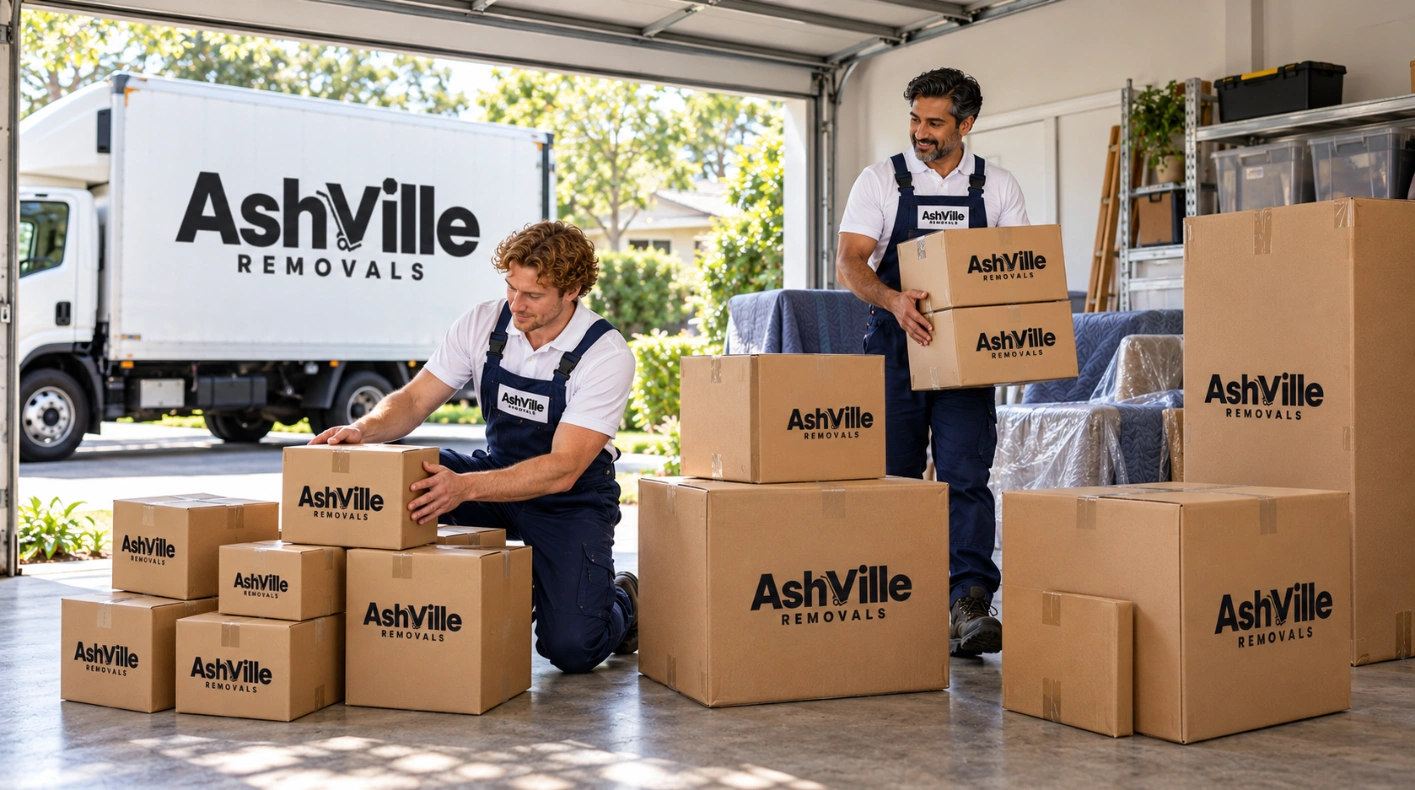
Free from your removalist. Every Ashville Removals booking includes free packing boxes as standard, and we deliver them before your move date. If you’d rather pack yourself, we also supply materials only and collect whatever you don’t use.
Bought new. Roughly $2–$4 per carton from hardware and storage retailers. Consistent sizing, which matters more than people expect — uniform boxes stack into a truck far more efficiently, and a tighter load means fewer trips.
Second-hand. Marketplace and community groups across Melbourne always have recently moved households giving boxes away. Free, but check for damp and crushed corners.
Supermarket boxes. Free, but avoid them for anything valuable. Produce cartons are often unsealed, inconsistently sized, and have been in cool rooms.
Common Mistakes That Blow Out Your Box Count
Packing heavy items in large boxes. A large carton of books can exceed 30kg. It will split, and it’s genuinely unsafe to lift.
Leaving boxes half full. Under-filled cartons collapse when stacked. Fill the gaps with towels or linen.
Forgetting the garage until the last week. Garages consistently produce double what people expect.
Not labelling by destination room. Unlabelled boxes get stacked in one pile at the new address, and you pay for the time it takes to sort them out afterwards. Write the room on two sides and the top of every carton — this is one of the highest-value 30 seconds in the whole process, and it’s covered in more detail in our ultimate packing guide for moving house in Australia.
Buying exactly the calculated number. Always buy 15% spare.
Frequently Asked Questions
How many boxes do I need for a 3 bedroom house? A three bedroom house typically needs 60–80 boxes: around 24 small, 28 medium, 18 large, and 4 wardrobe cartons. Add 10–20 more if you have a garage or garden shed, and expect the upper end of that range if you’ve lived in the property for more than three years.
How many boxes for a one bedroom apartment? A one bedroom apartment usually needs 25–35 boxes — roughly 10 small, 12 medium, 8 large, and 2 wardrobe cartons. A studio needs 15–25. Add extra if you own a lot of books or kitchen equipment.
How much should I expect to pay for moving boxes in Melbourne? New cartons cost roughly $2–$4 each, so a three bedroom house buying everything new would spend around $150–$250 including tape and bubble wrap. Ashville Removals includes free packing boxes with every booking, which removes most of that cost — see our budget moving guide for other ways to bring the total down.
How heavy should a moving box be? Keep every carton under 20kg, and ideally under 15kg. If you can’t lift it comfortably from the floor to waist height on your own, repack it into two smaller boxes.
Do removalists supply boxes, or do I buy my own? Both options exist. Ashville Removals supplies free boxes with every move across our local removalist service area, and we can also deliver a full materials pack if you’re packing yourself.
Get an Exact Estimate for Your Move
Box counts are a good planning tool, but nothing beats a proper look at your inventory. Tell us your home size, suburb, and move date, and we’ll come back within two hours with a written, itemised quote — including how many boxes we’ll drop off beforehand.
Get your free quote or call 0404 382 743.