
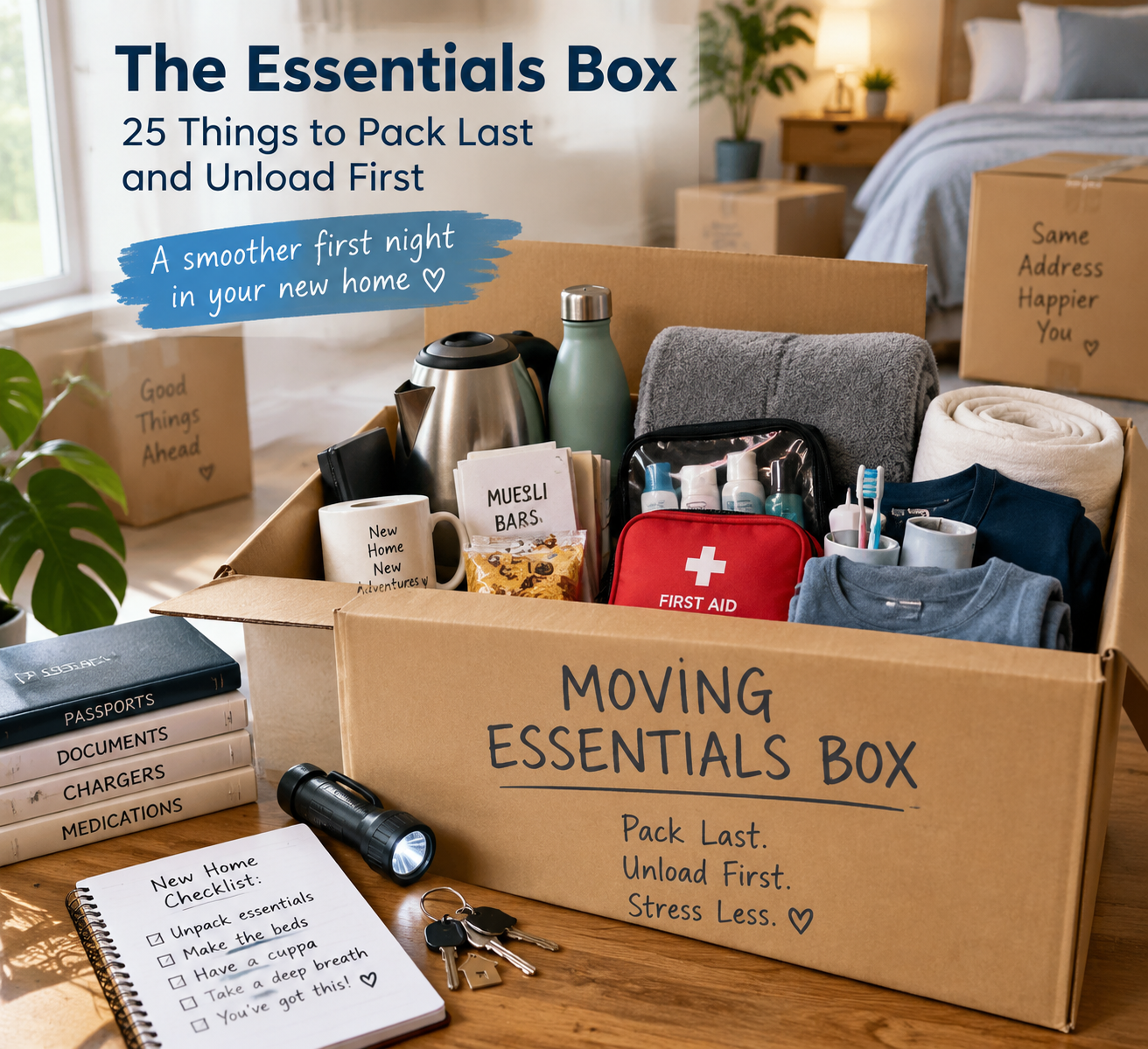
It is 9pm on moving day. The truck has gone. There are sixty sealed boxes stacked in rooms you do not know your way around yet, and you need a toothbrush, a towel, and something to drink out of.
You know all three are in the house somewhere. That is the problem.
This is the moment the essentials box exists for. It is one carton, packed last, loaded last, or carried in your own car, and opened first, and it is the difference between a manageable first night and an hour of tearing open boxes with a car key because you cannot find the scissors either.
Here is exactly what goes in it and what does not.
What Should Be in a Moving Essentials Box?
A moving essentials box should contain everything you need for the first 24 hours in your new home without opening another carton: bathroom basics, medications, a kettle and a few mugs, one set of bed linen per bed, two days of clothes, phone chargers, a torch, a basic toolkit, cleaning supplies, and your key documents.
Think of it as an overnight bag for the house rather than for you. If you would need it before you had the time and energy to unpack properly, it belongs in this box.
Why This One Box Matters More Than It Sounds
The first night in a new home is when you are most tired and least organized. You have been awake since 6am, you have made a hundred decisions, and your judgement is worse than you think.
The essentials box removes every decision from that window. You do not have to find anything, remember anything, or work out which carton the towels went in. You open one box, and the night is solved.
It also protects the things that genuinely cannot go missing. Medications, passports, chargers, and house keys should never be on a truck at all, and giving them a designated home stops them from ending up loose in a box labelled “misc.”
For interstate moves the box does more work again. If you are on a shared load service, your belongings may arrive days after you do, so the box has to cover the whole delivery window rather than one night. Our guide to dedicated truck versus shared load removals explains how long those windows typically run.
The 25 Things to Pack Last and Unload First
Bathroom and personal care
1. Toilet paper. Two rolls minimum, per bathroom. This is the item people forget and regret fastest.
2. Hand soap and a hand towel. Small, cheap, immediately necessary.
3. Toothbrushes and toothpaste. One brush per person, kept together in a bag so nothing gets lost in the bottom of the carton.
4. One bath towel per person. Plus a spare, because something will get spilled.
5. Shower basics. Shampoo, conditioner, and body wash are decanted into travel bottles if you want to save space. Bag anything liquid separately in case of leaks.
Health
6. Prescription medications and repeat scripts. Keep these with you personally, not just in the box. Include anything taken daily and enough for at least a week.
7. A basic first aid kit. Plasters, antiseptics, painkillers, and anything you use regularly. Moving day produces a reliable supply of small cuts and scraped knuckles.
Kitchen and food
8. The kettle. The single most requested item on any first night, in any household.
9. Mugs, teabags, coffee, and sugar. One mug per person plus a couple of spares for anyone who helps you.
10. Milk. A small carton of Long Life milk is easier than remembering to buy fresh on the way.
11. Two plates, two bowls, and cutlery per person, plus one sharp knife. Enough to eat a meal without unpacking the kitchen.
12. Bottled water and nonperishable snacks. Muesli bars, nuts, and crackers. You will eat these at 4pm when you realize you have not eaten since breakfast.
Sleep and clothing
13. One full set of bed linen per bed, plus a pillow each. Making the beds is the first thing you should do when the truck leaves, and it only works if the sheets are findable.
14. Two days of clothes per person, including sleepwear and underwear. Roll rather than fold to save space.
15. Closed shoes and a jumper. Melbourne evenings turn cold quickly, and a house with no curtains up yet holds very little heat.
Power and technology
16. Phone chargers and a power board. One charger per person, plus a multi-outlet board, because the first night usually involves everyone charging at once from whichever outlet you can find.
17. A torch and spare batteries. New homes have unfamiliar switchboards, and not every light will be working on day one.
18. The Wi-Fi router, modem, and cables. Keep them together in one bag with the account details. If you have connectivity on night one, everything else feels more manageable.
Tools and practical items
19. A basic toolkit. Screwdrivers, Allen keys, and an adjustable spanner. Bed frames and flat-pack furniture need reassembling, and the toolkit is always in the last box you open otherwise.
20. A box cutter and scissors. You need these to open every other box. Putting them inside a sealed carton is a mistake people make exactly once.
21. A cleaning kit. Multipurpose spray, microfibre cloths, paper towels, and a roll of bin liners. New homes are rarely as clean as promised, and you will want to wipe down shelves before anything goes in them.
Documents and access
22. A documents folder. Lease or settlement papers, ID, insurance details, your removalist quote and receipt, utility account numbers, and the agent or landlord’s contact details. Keep this in your car, not on the truck.
23. Keys, remotes, access cards, and your box inventory list. Label every key as you receive it. Access fobs for apartment buildings are expensive and slow to replace, and if you are moving into a high-rise, you will need them before the lift will work, which is one reason our apartment and high-rise moves team confirms access arrangements before the day.
Household extras
24. A kit for children or pets. Nappies, wipes, a favorite toy or comfort item, pet food, bowls, a lead, and a litter tray. Children and animals cope with the disruption far better when their own things appear immediately.
25. Marker pens, masking tape, and sticky notes. For labelling rooms at the new place, reseal anything you open and leave notes for whoever is helping. This is also what you use to write “Kitchen” and “Bedroom 1” on the doors, which speeds up the whole unload.
What Should I Pack Last When Moving?
Pack the essentials box in the final hour before the removalists arrive, after everything else is sealed. It should be the last thing you close, and, ideally, it should never go on the truck at all.
The sequence that works:
The week before, pack everything you will not use. Two days before, pack everything except the last few days of clothes, the bathroom, and the kitchen basics. The night before, pack the bathroom and the kitchen apart from the kettle. The morning of the move, pack the kettle, the last of the toiletries and the clothes you slept in, and seal the box.
Then put it in your own car. Not near the loading pile, where a helpful crew member will load it, which happens more often than you would expect.
If the box does have to travel on the truck, it goes on last and comes off first. Say so during the walkthrough when the crew arrives. Any decent crew will accommodate it without being asked twice, and the walkthrough is covered in more detail in our hour-by-hour moving day game plan.
What Not to Put in the Essentials Box
Anything valuable enough that losing it would be a real problem. Passports, birth certificates, jewelry, cash, laptops, and hard drives should be on your person or in your car, not in a carton that could be mistaken for general freight.
Anything you can buy for a few dollars on the way. The box has finite space, and half the reason people overload it is including things they could pick up at any supermarket.
Perishable food. It will sit in a warm car or truck all day.
Anything flammable or hazardous. Aerosols, gas canisters, and cleaning chemicals in concentrated form should not be on a truck at all.
How to Build It Properly
Use a distinctive box. A different color, bright tape, or simply the only box in the house wrapped in red tape. It needs to be identifiable from across a room at a glance.
Label it on all four sides and the top. Write “OPEN FIRST, DO NOT LOAD” in large letters, not just “essentials.”
Use one large box per household, or one medium box per person if you have a bigger family. Two clearly labelled boxes beat one that is too heavy to carry easily.
Keep it under 15 kg so anyone can carry it in one trip.
Pack a second box for day two if you want to be organized: a few more clothes, more kitchen items, and the coffee machine. Not essential, but it makes the second night easier too.
For everything outside this box, our ultimate packing guide for moving house in Australia covers the room-by-room method, and the moving box calculator by home size will tell you how many cartons you need overall.
Frequently Asked Questions
What should be in a moving essentials box?
Toilet paper, hand soap, toothbrushes, one towel per person, medications, a first aid kit, the kettle, mugs and teabags, basic crockery and cutlery, snacks and water, one set of bed linen per bed, two days of clothes, phone chargers and a power board, a torch, the Wi-Fi router, a basic toolkit, a box cutter, cleaning supplies, your documents folder, keys and access cards, and anything your children or pets need.
What should I pack last when moving?
Pack the essentials box last, in the final hour before the removalists arrive, after every other carton is sealed. Leave out only the kettle, the last of your toiletries, and one change of clothes until that morning, then seal the box and put it in your own car rather than on the truck.
Should the essentials box go on the truck?
Ideally not. Carry it in your own vehicle along with valuables and documents so it cannot be buried at the back of a load. If it must go on the truck, tell the crew leader during the arrival walkthrough so it is loaded last and unloaded first.
How big should a first-night box be?
One large carton for a couple or a single person, or one medium carton per person for a family. Keep every box under 15 kg so it can be carried in one trip, and label it clearly on all four sides and the top.
Do I need a bigger essentials box for an interstate move?
Yes, if you are using a shared load service. Your belongings may arrive several days after you do, so pack for the full delivery window rather than one night: more clothes, more kitchen items, bedding, and any work equipment you need. See our interstate removalists page for how delivery windows work on each route.
Moving Soon in Melbourne?
Free packing boxes with every booking, background-checked crews, full goods-in-transit insurance, and transparent hourly pricing. Written, itemized quote back within two hours.
Get your free quote or call 0404 382 743. Local removalists across 35+ Melbourne suburbs since 2013.